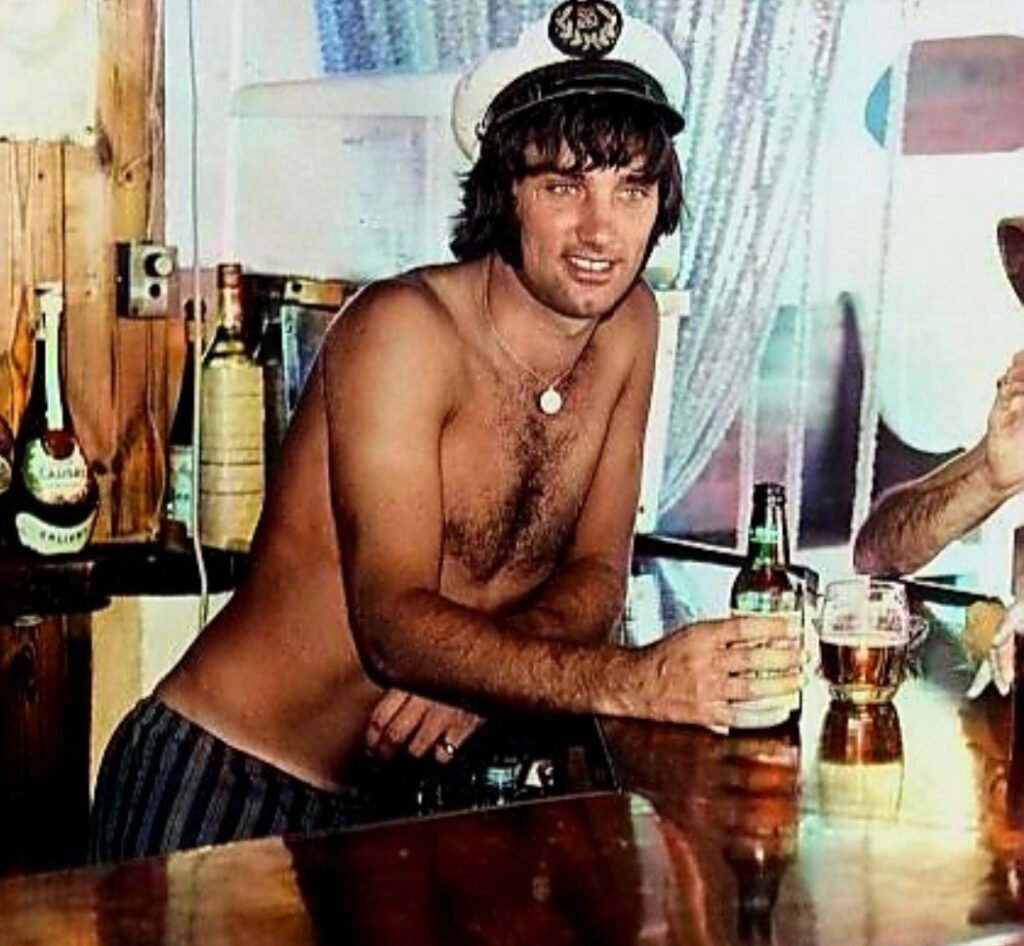
Who Was Hristo Stoichkov? A footballer by calling, a coach almost by accident; a natural-born goalscorer and a full-blooded provocateur — a barcelonista and an antimadridista in the truest sense of both words. A man whose volatile temperament often dragged not only himself, but his entire team, into trouble.
The Beast
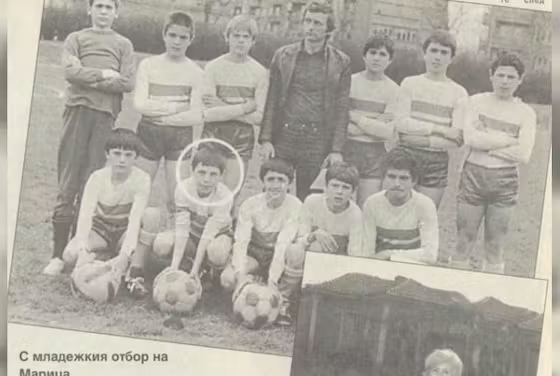
Hristo was born on February 8, 1966, in Plovdiv — a city that never tried to spoil anyone. Socialist everyday life was predictable to the point of numbness: the fridge was rarely empty, but dreams seldom reached beyond what you were allowed to have. In an ordinary apartment, Stoichko Stoichkov and Penka Stoichkova raised three children: the older Petya, the younger Tsanko, and between them a boy who learned very early that life meant fighting for your place.
He was not a child of silence. The courtyard was his first stadium, and the brutality of playground clashes was his first lesson in character. School against school, block against block — everyone against everyone. The pitches were hard as concrete, the ball often closer to a stone than sporting equipment, but that hardly mattered. What mattered was who could endure longer. The scars from those years stayed with him forever, like a map drawn beneath the skin.
His father, a goalkeeper connected to Spartak Plovdiv, offered an example — though not necessarily calm. Soon, the neighborhood began talking about the boy with something wild inside him: fast, explosive, instinctive. When someone threw a stone at him, he responded in a way that fit his reputation perfectly — not by retreating, but by attacking. Kids called him “the dog,” sometimes “the beast.” Years later, he admitted he had never been easy for teachers or neighbors.
Home was not a place of luxury, but of balance. His parents made sure the children stayed close. The best moments came in Yasno Pole, at his grandparents’ village, where the rules of the city faded away. There he learned work, and there the sense of loyalty was born — loyalty he would later repeat like a mantra, toward family, friends, and teammates.
School was never his natural environment. Stories about burned grade books and constant disciplinary trouble did not come from nowhere. Stoichkov learned early that it was easier to be a rebel than a student in a system that wanted everyone standing in neat rows. In a world where mediocrity felt safe, he chose risk.
That is why the appearance of Atanas Uzunov proved decisive. For many, he was just another unruly kid from the provinces; for Uzunov, he was raw material — a footballer who could not be tamed, only guided. The road to Hebros Harmanli was his first real step beyond the familiar streets of Plovdiv. He left behind playground fights and school conflicts, though in truth he carried them with him, as if they were part of his DNA.
With Uzunov’s help — a respected official, coach, and referee — he joined Hebros Harmanli. Two years later, he signed with CSKA Sofia, one of the country’s giants. He walked into the mythical dressing room and calmly took the seat reserved for the captain. Someone asked who he thought he was.
I’m Stoichkov,” he replied.
“The Cup Is Ours!”
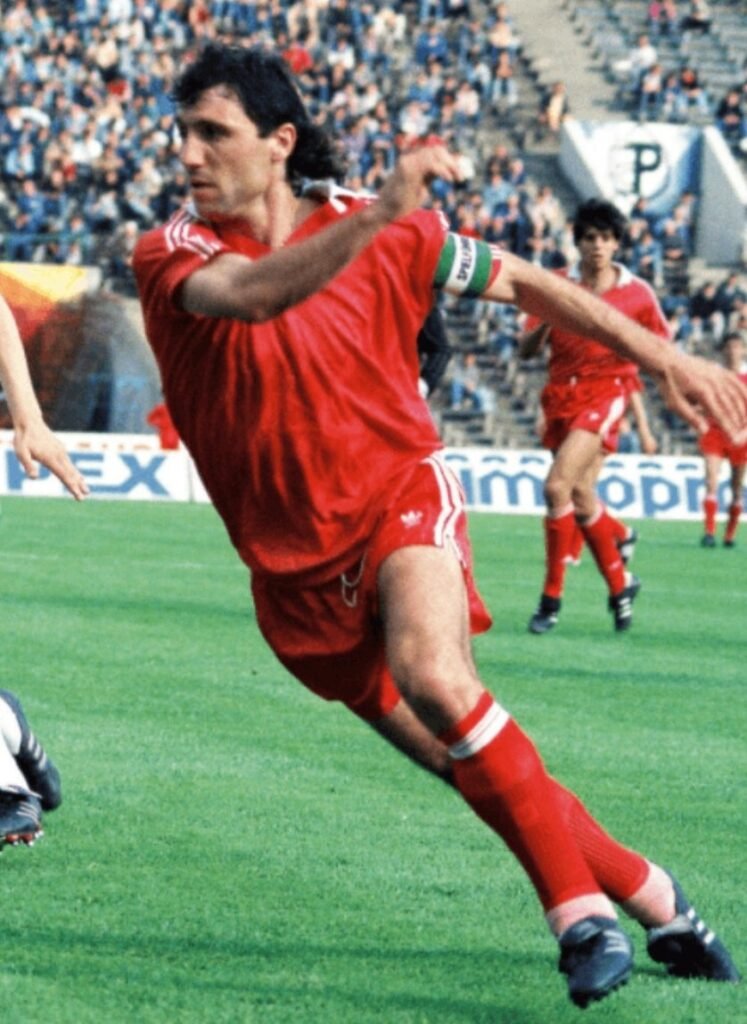
He made his debut for the capital club on February 23, 1985. The beginning could hardly have been better: a league title and a domestic cup. In the final of the latter, CSKA beat Spartak-Levski Sofia 2–1, but Stoichkov was disqualified after the match. What began as shoving soon turned into a full-scale battle. Just when things seemed to calm down, the 19-year-old stormed into the opponents’ dressing room, shouting: “This cup is ours!”
The military regime responded swiftly. He was sent to the barracks. It became the hardest half-year of his life. Each morning, he woke before dawn to patrol farm areas. Often, he had little to eat; older soldiers mocked his height and bowed legs. Fights were frequent, punishments inevitable. The mildest penalty was cleaning the latrines.
When Bulgaria qualified for the World Cup in Mexico, an amnesty was granted to those punished after the cup final. Stoichkov returned to football after 10 months and 8 days away from his closest companion — the ball. Many expected a changed Hristo: obedient, subdued, disciplined. After all, the army had tried to break him.
“They judged me — people who know nothing about football,” he said upon returning. “They never played the game. They couldn’t tell a ball from a watermelon.”
In 1987, CSKA won the domestic double, and Stoichkov scored seven goals. Not many. For him, it was never enough.
First Contact with Another Planet
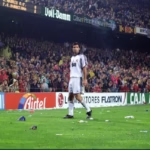
In the spring of 1989, Stoichkov arrived at Camp Nou for the first time, still wearing the colors of CSKA Sofia. The prize was a place in the Cup Winners’ Cup final.
“I looked at them before the match and felt fear,” he later recalled. “Cruyff was the coach — then Bakero, Alexanco, Amor, Eusebio, Txiki, Zubizarreta… They started playing immediately. They passed, we chased. It was like traveling to another planet — different football, culture, climate, people. I kept thinking about what I had to do to stay here forever.”
Barça won 4–2 and secured their place in the Bern final, but the crowd remembered the Bulgarian who, in the 24th minute, went one-on-one with Andoni Zubizarreta and lifted a velvet-soft lob into the net. He added a penalty later, though goals from Lineker, Amor, Bakero, and Salinas gave the Catalans breathing room. That night, Johan Cruyff decided his team needed a small, fast attacker.
He chose Stoichkov.
Cruyff’s Planet
Cruyff did not need many minutes to make up his mind. Statistics and boardroom opinions meant little to him. One look at the stocky forward running across Camp Nou as if trying to prove something to the world was enough. Barcelona were searching not just for quality, but for character. Stoichkov had both — even if the second came like a grenade without a pin.
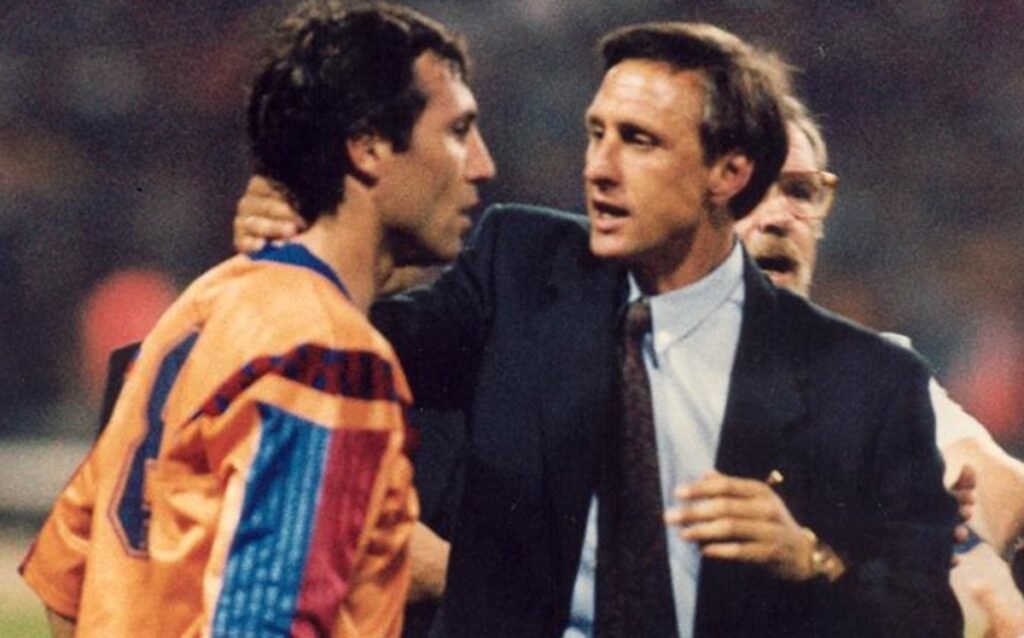
The transfer was not a fairy tale about dreams fulfilled. It was a cold collision between two worlds: Catalan elegance and Cruyff’s philosophy on one side, a boy shaped by military clubs on the other, where shouting was part of daily language. The first weeks in Spain felt like learning to walk again. New language, new rhythm of life, a different way of seeing football. In Bulgaria, you conquered the ball through combat. In Barcelona, through space and thought.
Cruyff saw more than a scorer. He insisted Stoichkov had to learn to breathe with the ball, not just chase it. Training sessions were shorter, but mentally exhausting. For someone who had lived by impulse, it felt like locking a wild animal inside a cage of principles.
“Champions One Hundred Percent, Catalans One Hundred Percent!”
His first season at Camp Nou tasted both sweet and bitter. In December, during an El Clásico for the Spanish Super Cup, he clashed with Basque referee Urizar Azpitarte. First, Cruyff was sent off, then the furious Bulgarian. On his way down the tunnel, he stepped on the referee’s foot — scandal followed. Initially banned for six months, the suspension was later reduced to two, but the incident marked his relationship with Spanish officiating for years.
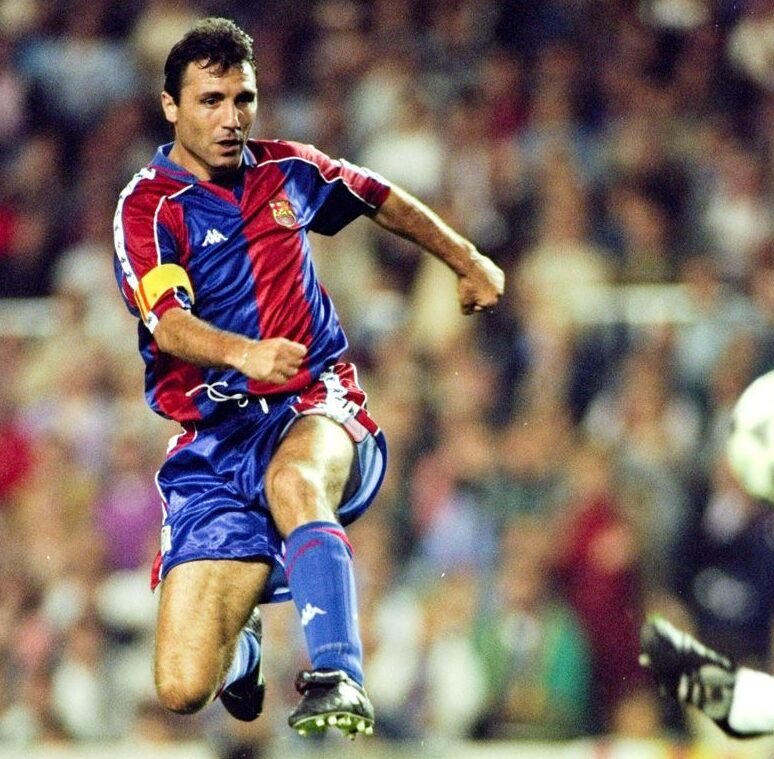
Despite everything, he scored 14 goals in his debut campaign — only five fewer than Pichichi winner Emilio Butragueño. Individual honors mattered less: Barça ended a six-year wait for the league title, finishing ahead of Real Madrid. Yet Stoichkov’s Barcelona era often felt like a belle époque dragging a fin de siècle behind it. He netted six times in the Cup Winners’ Cup, but missed the final through injury.
In 1991/92, he improved his scoring tally — 17 goals in 32 games — as Barça won another league title and the Spanish Super Cup. The best was still to come. On May 20, 1992, against Sampdoria, Barcelona lifted their first European Cup after extra time. Stoichkov became the first Bulgarian ever to win it. At Plaça de Sant Jaume, amid the celebrations, he shouted: “Champions one hundred percent, Catalans one hundred percent!”
That same year, he narrowly lost the Ballon d’Or to Marco van Basten by just 18 votes.
“I should have won,” he said. “Berlusconi had his hand in it.”
Two years later, revenge arrived: Stoichkov collected 210 votes, comfortably ahead of Roberto Baggio and Paolo Maldini.
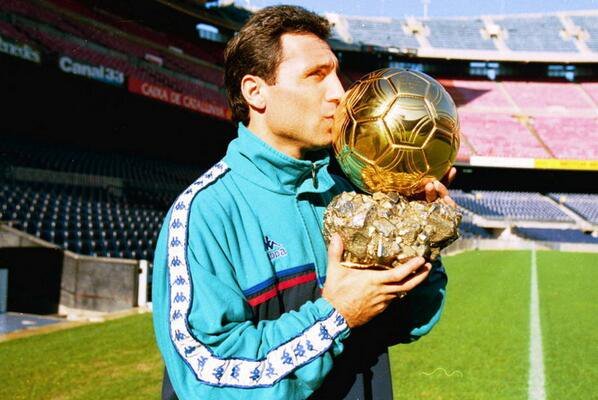
“200 Million from My Own Pocket”
On November 17, 1993, Bulgaria defeated France in Paris to qualify for the USA World Cup. After a heavy opening defeat to Nigeria, Stoichkov converted two penalties in a 4–0 win over Greece — Bulgaria’s first ever World Cup victory. What followed became a fairy tale: wins over Argentina, Mexico, and Germany.
“We drank, we smoked, we played cards,” he later admitted. “We came to win one match and finished fourth.”
That summer, Cruyff wanted Romário. Spanish rules allowed only three foreign players, and Stoichkov did not stay quiet.
“A fourth foreigner is nonsense,” he said. “If they must buy someone, bring my friend Lubo Penev. Romário costs 600 million pesetas? I’ll add 200 million from my own savings.”
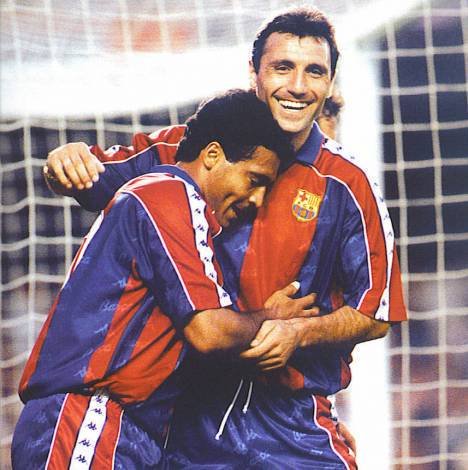
He eventually built a good relationship with the Brazilian, but rotation policies weakened his role. Romário became league top scorer; Barça won a fourth straight title. Yet the heavy defeat to Milan in the European Cup final marked the beginning of the Dream Team’s decline — and Stoichkov’s.
Full Stop in Barcelona
The years that followed brought more setbacks. Bulgaria’s Euro 1996 ended early despite Stoichkov making the Team of the Tournament. He returned to Barcelona that summer but struggled under Bobby Robson’s hierarchy behind Ronaldo, Luis Enrique, and Pizzi. Seven goals and two trophies were not enough; many felt the “Vulgar Bulgar” had lost his edge.
Conflict with Louis van Gaal led to a loan back to CSKA, then a move to Parma, where he never clicked with Gianfranco Zola. Later came Saudi Arabia, Japan, and the MLS — chapters that felt more like epilogues than new beginnings.
In the end, he closed the circle in Barcelona, alongside Cruyff and Joan Laporta. He loved Catalonia, and Catalonia loved him back. During the 1998 World Cup, he hung a senyera from his hotel window and campaigned for recognition of the Catalan national team.
He tried coaching — at Barcelona’s youth side, Celta Vigo, even Bulgaria — but never quite found the same fire. Perhaps because Stoichkov was never meant to observe the game from the sidelines. He belonged inside the storm.
In 1994, he supported a centrist party in Bulgaria’s parliamentary elections; posters with his face flooded Sofia. Nobody seemed to mind. Bulgarians adored football’s greatest renegade then — and, in many ways, still do. At the foot of Mount Vitosha, a Barcelona supporters’ club still carries his name: Penya Hristo Stoichkov.
Off the field, family is everything
Stoichkov’s family was never part of his on-stage persona. In his autobiography, Mariana appears without grand declarations — simply as someone who stood by him from Sofia to Barcelona, through suspensions and conflicts alike. There’s no narrative about her “fixing” his character. Instead, it’s a portrait of everyday life alongside a player who operated at high emotional voltage for most of his career.
The birth of his daughters coincided with his rise to the very top at Barcelona, and that’s when he begins to describe home as a space cut off from the noise of football. He recalls going straight back to his family after training sessions, avoiding the nightlife that, in that era, was almost expected of La Liga stars. It doesn’t read like a moral transformation — more like a pragmatic choice from someone who knew his temperament already created enough chaos on its own.
What stands out most, however, is the selectiveness of his storytelling. Stoichkov deliberately avoids expanding on private details. He leaves them in the background, separating two roles: the public provocateur and the man who, away from the pitch, was searching for something as simple as stability.
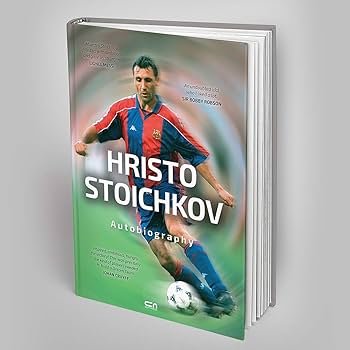
Hristo Stoichkov. Autobiography
A searing confession by one of the most incendiary players in the history of football!
The only one in the world to have been awarded the Ballon d’Or after a communist regime banned him from playing professionally. Hristo Stoichkov – El Pistolero of the legendary Barcelona Dream Team stands before you with his autobiography!